
Document Options Schematic Services

Document Options Limited – Invoice Data Reading as a Service

00PartnersTags: ,


Document Options Limited offers invoice capture and data collection as a service

Invoice data collection as a service is used by organsiations as an addition to document capture and archiving

Introduction
Document Options Limited (DOL) are an award-winning provider of process automation, document management and document capture services and are a long-standing partner of FIS Information Systems.
Historically, scanning bureaus focus on the business of archiving documents after they have been processed. However, Document Options also provide their customers with a new service to digitise paper invoices and also to extract the key invoice data content at the first stage of the process.
The shift from "late invoice" archiving to "early invoice" archiving has transformed the accounts payable function of many organisations.
Invoice collection as a service
The invoice data collection service is available for all organisations and is not restricted only to organisations with SAP.
By combining expertise in high resolution image capture, OCR invoice reading technology and invoice completion, Document Options provide an unrivalled service for accurate invoice data capture and rapid document throughput.
 
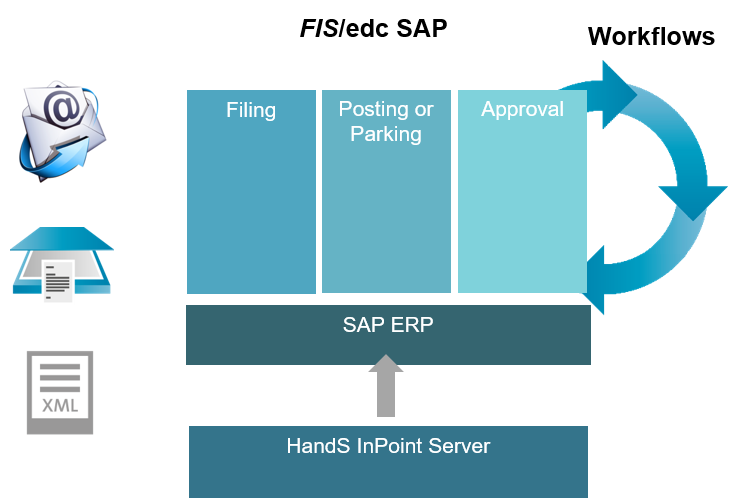
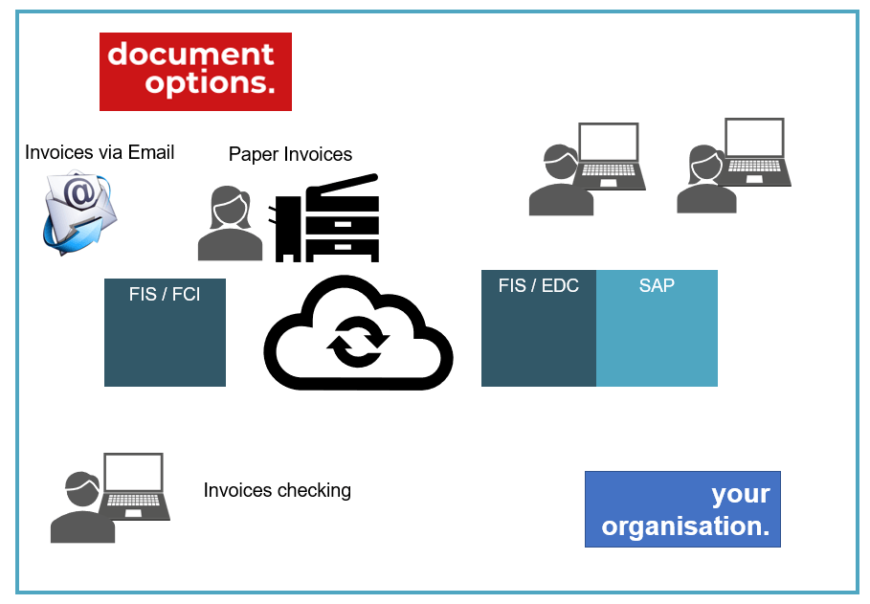
Invoice Reading as a service schematic
Who is it for?
For organisations with who wish to:
  • Out-source the routine tasks of manual data-entry and document scanning as part of their accounts function
  • Improve the quality of their invoice data in their ERP or Financials software
  • Re-engineer their accounts payable function by working with a specialist services organisation at the first part of the invoice classification process

Key Information: Document Options Limited

Complete invoice reading process including:
  • Invoice transportation service from customer site to the DOL base in Crawley
  • High-resolution document capture of paper invoices
  • Capture of emailed invoice attachments
  • Invoice content reading services - i.e. header and line items
  • High accuracy of data capture - by checking for missing fields and data viability
  • Fast turn-around service
  • Working with FIS Information Systems directly to provide unmatched services levels
Working from home and hybrid working
Many customers have adapted to the change in working practices.
With working from home or hybrid working a preferred option - Document Options are able to collect paper invoices and transport them to their UK offices.
In this way customers can still work from home without needing to travel to the office to scan invoices . The task of image capture and invoice data collection could be outsourced to an organisation with Document Option's expertise and experience.


inPoint Archive Document Server

HandS Landing Page

00PartnersTags: ,

HandS software logo

H&S Information Architects partner FIS with an SAP Certified Document Archive

The InPoint CSS Content Server for SAP Business Solutions provides a secure access to documents processed in SAP ERP (ECC 6 or S/4HANA) and FIS / edc monitors 

HandS SAP Document Archive
Who is the SAP Certified Document Archive for?

For organisations who wish to view invoices (and other documents) securely within FIS / edc and SAP transactions.

Key Benefits:

  • SAP Certified Document Archive software solution working with SAP-Archive Link
  • Displays images in SAP ERP (i.e. MIRO and MIR4 transactions) and FIS / edc (i.e. SAP GUI, Web Dynpro Approval Workflow, Fiori App Approval workflow)
  • Retention time can be set for archived invoices – after this period, the image can be deleted if there is no statutory legal requirement
  • inPoint CSS Server can be expanded to view other documents via Web Interface
  • Administration is available with fundamental SAP expertise
  • Compatible with SAP release for ECC 6 and S/4HANA
  • Presents EDI invoices as a stored PDF image – invoice data simulation
  • Provides security and additional space compared to using a File Server for document storage
  • Professional Services from an SAP certified partner

Emirates and Dnata Food Services Logo

Eight Fifty Food Group Logo

Youngs Seafood logo

Palm Pager Logo

 
Neural Network Mind Reduced_1

FIS / FIS EDC Machine Learning

00SAP Invoice ProcessingTags: , ,


Artificial Intelligence and Machine Learning Introduction and Developments

Find out how FIS and SAP are creating new machine learning technologies to solve real business problems

Neural Network and machine learning

SAP Business Technology Platform

Artificial intelligence (AI) and machine learning (ML) are now being used by organisations of all sizes and across a diverse range of industries. Intelligent technologies support the digital transformation of companies and are becoming more important. 

SAP provides basic functionalities for the development of modern Artificial Intelligence solutions with the SAP Business Technology Platform. The portfolio includes numerous innovative technologies, such as Artificial Intelligence, Machine Learning, Internet of Things (IoT), Big Data and Blockchain.

The platform provides application developers with comprehensive functions and a wide development environment they can use to enhance, integrate and quickly create innovative applications themselves without any infrastructure maintenance tasks.

Your benefits by implementing intelligent SAP Technologies

  • Smooth integration of AI applications
  • Easy adjustment, enhancement, optimisation and automation of processes
  • Simplified and faster work flows
  • Data-driven services can be provided immediately
  • Detailed forecasts and, consequently, faster decision making on a strong data basis
  • Creation of new data-based business models
  • Improved adaptability to market changes
  • Increased competitiveness and efficiency
  • Directly measurable added value through cost reduction and time saving

Artificial intelligence and Machine Learning

Artificial Intelligence means the capacity of machines and systems to imitate human actions in order to simulate intelligent behaviour. It is either the fulfilment of specific tasks, such as advertising personalisation (applied AI), or more comprehensive activities, where entire systems or devices completely imitate human behaviour (general AI).

Contrary to many opinions, Machine Learning (ML) is not the same as AI. Machine Learning is part of Artificial Intelligence focusing on algorithms and mathematic models.

This intelligence is “trained” in such a way that it can solve any occurring problems by itself by developing the appropriate AI algorithms. The bigger the dataset and the number of sources, the more successful AI technology will be.

Machine Learning is essentially a sub-division of Artificial Intelligence. It is about imparting knowledge to machines or computers. To this end, a neural network or models need to be trained with data, such as texts or images.

The respective data can be unstructured financial data from the SAP system for instance. From the mass of training data, the system extracts characteristic features to enable a direct recognition and assignment of the data imported in the future based on these features.

Overview of SAP intelligent technologies

  • Conversational Artificial Intelligence (AI or CI) includes the entirety of intelligent technologies standing behind automated message transmission and voice-activated applications. They enable human-like interactions between computers and humans. As a result, users will be guided and supported in their daily business.
  • Intelligent Robotic Process Automation (IRPA) is the combination of RPA, ML and AI. Tasks, such as the processing of messages and orders or the execution of data transfers, are assigned to digital robots or “bots”. These bots efficiently implement time-consuming and repeating processes.
  • Internet of Things (IoT) means the networking of devices, machines and installations with and through the Internet. Sensor data transferred in real time increase the transparency of business processes. Decisions based on this data will be made proactively and more quickly.
  • Machine Learning (ML)  IT systems (machine learning models) are trained on the basis of existing datasets and algorithms enabling them to identify patterns and rules and use them to develop results by themselves. In this way, business decisions are optimized or even made automatically.

FIS Machine Learning Applications and Development

Usually, self-learning technologies, such as ML, become relevant if applications cannot be optimised or developed in a rules-based way. The FIS professionals work every day on testing and further developing innovations by using ML, RPA and bots. FIS, for instance, enhances its own products through the use of machine learning or further develops customer-specific ideas and proposals.

FIS strategy has always been to put the customer requirements at the centre of our thinking. That is why FIS offers both SAP applications and our own self-developed optimisation applications, with teams of experts who will work with you to find technology solutions for your specific challenges.

As an example, within our SAP integrated invoice processing solution, FIS / edc (invoice monitor), the two main technology components use machine learning technologies to automate the invoice throughputs with less human intervention.

In the FIS OCR data reading application (FIS / fci), the embedded machine learning technology is able to extract the key content from an invoice in the same way that an individual would recognise the data (i.e. data in the vicinity of key words and prefixes) and then later stores the key data in a knowledge base for subsequent invoices from the same supplier.

In the SAP integrated invoice processing module (FIS / edc), machine learning can be used to create automatic account assignments and direct FI invoices to the correct individuals or groups based on the experience of previous postings.


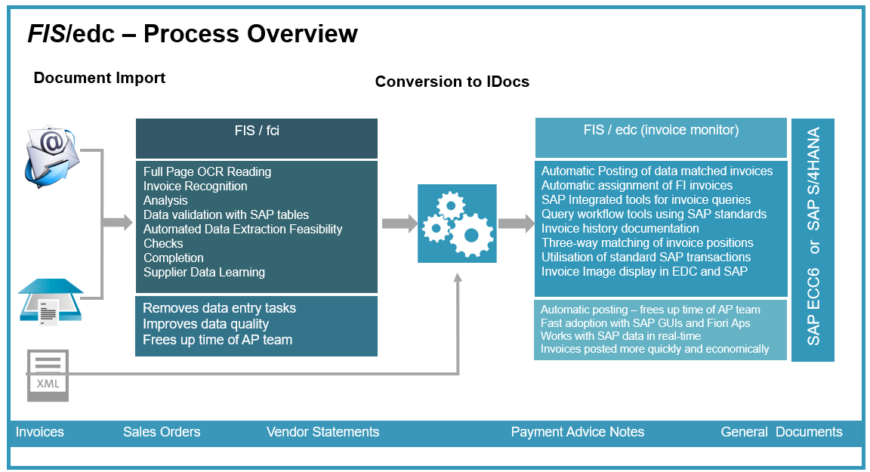
FIS EDC invoice processing diagram

00SAP Invoice ProcessingTags: , , ,

OCR invoice data collection technologies and functionality

Advanced technologies work together ensuring that invoice data is collected automatically and accurately. The invoice reader uses validation and viability checks prior to the data export to SAP or Financials.

Introduction
The video highlights some of the advanced technologies that are applied to the task of automated invoice data collection.
The technologies ensure that invoices are correctly classified and the data quality is maintained, prior to transfer to SAP / ERP.
The technologies significantly reduce the workload of the accounts payable team.
Who is it for?
For organisations with SAP ERP (ECC 6 or S/4 HANA) who wish to:
  • Replace time consuming tasks such as manual data-entry when processing invoices
  • Improve the invoice data quality in SAP  by utilising tables from SAP for company code identification, PO validation, current tax values, and supplier identification
  • Make savings by reducing invoice processing costs, making a significant improvement in data quality
  • Reduce the workload for the accounts payable team
  • Reduce the payment times for vendors by processing invoices in a timely manner
Key Information:
Functions of OCR Reader and Integrated Invoice Processing
 

Emailed invoices are automatically forwarded to FIS / fci (the invoice data collection component) and then archived for retrieval in SAP / ERP. Therefore, no need for manual tasks such as printing, scanning and keying-in invoice data

Multiple OCR engines are employed. The data from all engines is compared to support data quality.
Invoice classification is confirmed against standard tables in SAP / ERP to highlight potential errors in the invoice data.
"Fuzzy logic" is used for comparing invoice data (i.e. supplier recognition) with reference data to compensate for inexact data on the invoice or within the SAP master data.
Freeform recognition technology automatically searches for data in the vicinity of keywords to collect the key invoice data from day-one.
Machine learning. An intelligent knowledge base is used to collect the key invoice data. The knowledge-base uses machine learning by analysing the co-ordinates of previous successfully read invoices from each supplier.


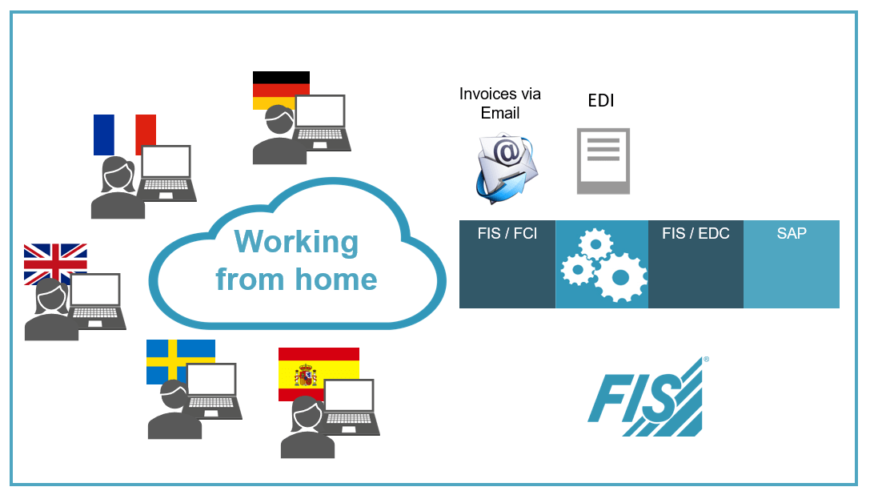
schematic diagram working from home with FIS

00SAP Invoice ProcessingTags: , , ,


Automated invoice data collection from day one

Advanced OCR technologies are employed to accurately collect the key data from invoices and other financial documents. The invoice data is checked for viability prior to posting into SAP or other ERP/Financials. As most invoices are processed without manual data-entry, workload is reduced, financial savings are generated and data accuracy improved. 

Introduction
By introducing technology to automate invoice data collection and check for potential errors, the invoice reading process becomes more efficient and the quality of the key invoice data is improved.
Accounts Payable Teams will benefit from  reduced workload as the number of data-entry tasks and reduced and the pre-SAP/ERP classification of invoices is eliminated.
Who is it for?
For organisations who wish to
  • Automate invoice data collection and reduce the workload of their accounts payable team
  • Remove labour intensive and expensive stages of invoice classification by eliminating the need for bar-code label additions to invoices
  • Make savings by capturing invoice data at the first stage (early invoicing) rather than scanning invoices (or using a bureau service) retrospectively
  • Support the accounts payable team working from home by recommending that suppliers send invoices electronically via email attachments
  • Improve data quality by installing technologies with validation and viability checks
Automating invoice data collection and reducing manual data-entry
The FIS invoice reading technology is designed to model the way in which a human would inspect an invoice – reviewing the key invoice data (using multiple OCR engines) and searching for the data in the vicinity of key words and phrases.
Data is validated and against SAP/ERP tables where applicable. 
The data from each supplier is stored automatically in a knowledge-base that gains experience with each supplier invoice.
Tasks that are replaced include
  • Significant reduction in workload as data-entry tasks by the accounts payable team are automated
  • No requirement for bar-code labels to be added to each invoice
  • No requirement for emailed invoices to be printed or scanned
  • No retrospective scanning of invoices or using a bureau service for "late archiving"
  • No need for manual invoice classification into categories such as company codes, currencies, invoice type (PO or PO-exempt)
Remote and hybrid working

Invoice processing remote working

The invoice data collection is an ideal technology for accounts teams that work remotely. The technology works automatically with emailed invoices where they can be forwarded directly into the OCR  technology, FIS / FCI, for automated invoice data collection.


FIS EDC invoice processing diagram

00SAP Invoice ProcessingTags: , , , , ,

Make savings by automating invoice postings in SAP

FIS invoice processing technology automates data-entry, freeing up accounts payable resource. Invoices are processed in any layout, in different languages and currencies. The invoice processing  technology assists with supporting colleagues working from home.

Introduction

FIS develops software that computerizes repetitive digital tasks that are normally carried out by people. The technology combines emulating how humans read computer screens and collecting data to automate tasks in the future.

The invoice processing technology reduces accounts payable workload and generates financial savings for organisations.

  • Reducing overall workload and manual data-entry tasks
  • Posting a high percentage of invoices automatically into SAP (no touch processing)
  • Automatically forwarding FI (PO- exempt) invoices to individuals or groups
  • Providing a familiar SAP environment for invoice queries and approval workflow

Automated invoice data collection 

FIS have developed one of the most effective technologies used for collecting key supplier invoice data from a scanned or emailed attachment. By introducing technologies into the invoice data collection process there is less manual keying and improved invoice data quality. Key invoice data can now be read from invoices with different formats, languages or currencies.

SAP integrated invoice matching and posting 

As an integrated add-in to standard SAP, the invoice monitor technology enables invoices to be posted automatically. Parked invoices can be directed to designated approvers or groups.

The invoice monitor, FIS / edc, complements SAP ERP, creating new functions for the accounts payable team and approvers. The invoice monitor referencing real-time SAP data and enables incoming invoices to be identified as either payable or parked.

In addition workflows are incorporated into the invoice monitor to manage approvals. Additional functions are aimed at invoice assignments and complex invoice coding tasks.

In combination, FIS offer an enhanced process that releases accounts payable teams from routine tasks and reduces workload. A high proportion of invoices are posted to SAP without any manual intervention

Functions of OCR Reader and Integrated Invoice Processing

Key Benefits

Reduced Effort for AP Team and Machine Learning. Invoice content is collected automatically from day-one, so manual data-entry tasks are reduced. In time, the  data collection technology "learns" the zones where the key data on an invoice resides for each supplier in a "knowledge database".  This means that key data is read automatically from the electronic invoice.

Invoices (MM) that agree with the original PO and Goods Receipt Note (GRN) in SAP could be posted automatically. PO exempt invoices (FI) can be assigned to accounts and forwarded automatically to individuals or departments.
Improved data quality. In the invoice data extraction component, invoice data is checked against SAP tables for vendor, company code and PO recognition. Net, tax and gross values are calculated to ensure that the data has been read correctly. Furthermore, the document can be classified (invoice, credit-note.. etc.) and assigned to the correct company code automatically.
Rapid adoption. As with all FIS add-in technologies, FIS / edc complements and works with standard SAP ERP (SAP ECC 6 or S/4HANA) presenting data from SAP transactions and new FIS transactions to assist with invoice queries.
Accounts Payable teams work within standard SAP GUI display formats and approvers use FIS / edc approval workflows running on SAP Web Dynpro and Fiori App standards. By developing proprietary technologies using SAP platforms means that FIS applications are easy to adopt for organisations already familiar with standard SAP.
Deep integration with SAP standard. FIS / edc harnesses the intrinsic power of SAP with no modifications to SAP standard being necessary. The processing technology presents information in real-time from the SAP database. SAP add-ins are easier to maintain when SAP upgrades and enhancement packs are introduced.

Invoice processing remote working

Flexible  / Hybrid working
Many FIS customers have adapted to the change in working practices of working fully or partially from home. Firstly, most customers have worked with their suppliers to further increased the proportion of invoices received via email - and reduced the volume received in paper format.
In this way, invoices are read automatically and manual completions, if required, can be actioned remotely. FIS / edc is also able to accommodate electronic invoices (EDI) and checks their credentials before posting.
Adopting an electronic method of invoice recognition means that organisations are not unduly hindered by the accounts payable team working from home.


computer code

FIS SST case study 5 – Automotive B2B

00Services

FIS - Nearshore Application Development Services (Poland)

Case Study: Automotive Retail Platform.

How FIS SST nearshoring services assisted on-line automotive retailer Auto Online, to create a platform to facilitate B2B transactions

cars on a forecourt

Introduction

Initially, retailer Auto Online were considering developing a new vehicle valuation tool by working with IT contractors. However, because the roadmap of the solution planned several new enhancements and additional functions, a nearshoring application development team  from FIS SST were selected.

Auto Online opted for a long term partnership with FIS SST that ensured continuity. FIS SST and also provided the the retailer the advantage of a resource with a wider range of technology competencies.

Challenges

The new Auto Online portal had to be built to facilitate a dynamic market with over 4,000 vehicle transactions per day.

Project management of the tasks between the  business requirements and the nearshoring application development team was based on SCRUM methodology. It was Auto Online's preference was to develop each module using Microsoft  .NET technologies. The new application was to be available in three languages - English, German and Polish.

The first solution, ‘Fleet Online’ , created a web application for marketing pre-owned fleet cars and lease returns. FIS SST provided the application development as well as the technical support.

The B2B model was then extended to include:

  • Trace Online’ – to display the procurement process of vehicles
  • ‘Easy Online’ - a web-based auction software for commercial car buyers and retailers
  • Value Online’ – a desktop application that identifies the location of vehicles

The web-applications were also integrated with backend systems from insurance company PZU.

 
computer code

FIS SST case study 2 – AI in Healthcare

00Services

Nearshore Application Development Services (Poland)

Case Study: Healthcare / Artificial Intelligence for Medical Image Classification

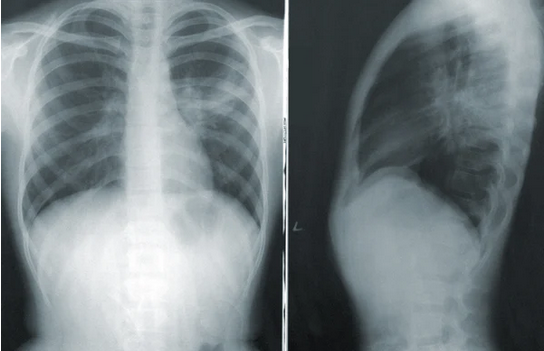
FIS SST nearshoring team looking into the research of using computer based classification of x-rays. Use of machine learning to potentially detect lung cancer in patients

X-ray of lungs

Introduction

FIS SST worked on a research project, looking to establish if machine learning could be used to provide a reliable method of classification between healthy and unhealthy x-ray images of patient lungs.

Two of the core technologies FIS SST employed for the machine learning project included:

Tensorflow - an end-to-end platform for training machine learning models

Keras - a deep learning framework technology.

Challenges

  • Data selection and x-ray images preparation for building the machine learning models
  • Access to reference data for health individuals
  • Lack of medical expert knowledge on the assessment of x-rays
  • Various file formats for the X-ray images


computer code

FIS SST case study 1 – Healthcare Migration

00Services

Migration of electronic patient records system

Migration of an electronic patient records system using nearshoring services from FIS SST. The legacy system suffered with poor performance and security issues and was not supported by modern browsers

Surgion with mask looking at medical data

FIS SST were selected to provide application development assistance for the migration of electronic patient records system using nearshoring services. The work involved updating an existing electronic patient records system (EPRS) to a more modern IT architecture for a leading Medical Group. The existing system was web-based and supported patient care from registration through to final test results.

Existing System

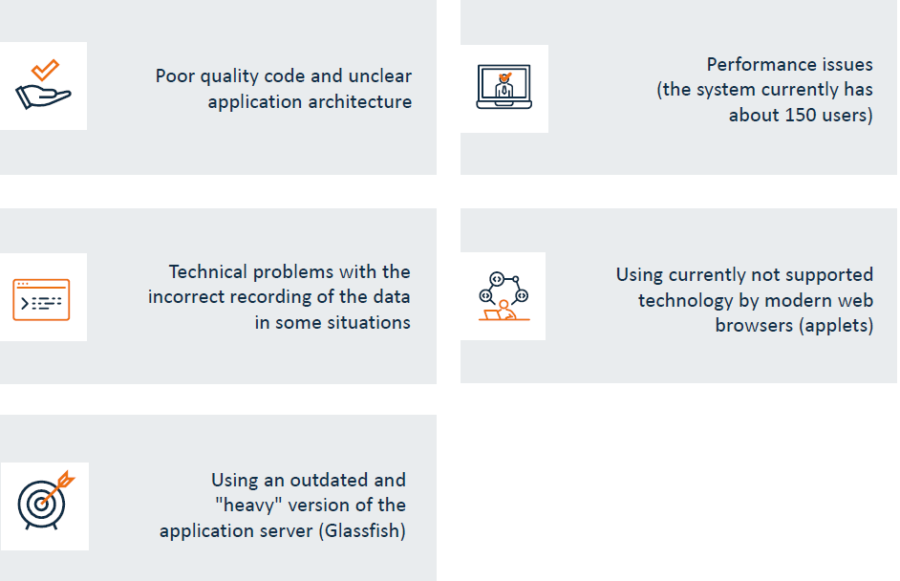
The system was utilised by more than 150 users including doctors, technicians, radiologists, receptionists and support workers.

The system prior to migration consisted of:

  • Java Enterprise Edition Framework (back-end) and PrimeFaces (front-end)
  • Glassfish application required to run the EPRS system
  • Some components implemented as JAVA applets

The system also included data such as:

  • Personal data of the patient
  • Patient Identification data
  • Results of medical examination (i.e. MRI, CT, ultrasound tests)
  • Calendar of for the availability of medical tests
  • Identification of the medical locations and medical team members
  • Dates of contracts and payments
  • Electronic Signatures

The electronic patient records system included a workflow system that recorded the treatments and results during the patient's stay at the healthcare provider.

Typically this would include:

  • Patient registration by reception staff
  • Examination findings by medical technicians
  • Description of the examination performed by radiologists – audio recordings
  • Preparation of test results by an assistant – text form of audio recordings
  • Acceptance of the examination by a Doctor with an electronic signature
  • Issue of a paper or electronic (i.e. CD ) record of the test results for the patient by reception staff

Shortcomings of the Legacy System

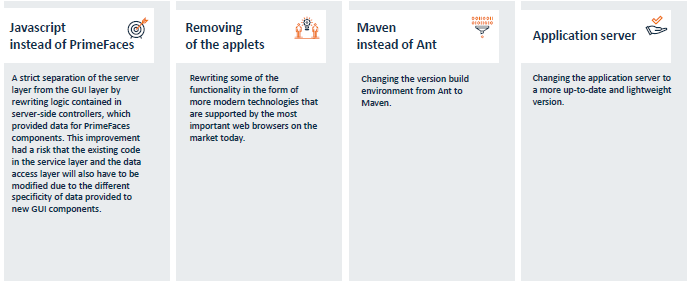
shortcomings of original electronic patient records systems

Key Migration Updates

New applications revision

New System Migration

The FIS SST development team collaborated with the client who provided source-codes and a test version of the legacy application. FIS SST used SCRUM methodology for the system migration project.

The new technology migration yielded key improvements to the existing system:

  • Improvement in the system code and application architecture
  • Improved stability and performance
  • Resolving technical problems with incorrect recording of data
  • Transition to new technologies that are supported by modern browsers
  • Improved level of system security
  • Transition to the latest version of the application server 

 
FIS-news-square

New Marketplaces for FIS / TradeFlex

00NewsTags: , ,

New FIS / TradeFlex Marketplace Integrations in 2021

FIS / TradeFlex is a centralised management platform that brings together SAP (ECC or S/4HANA) and several e-commerce marketplaces. The software was launched in 2020 and at that time had integration with both Amazon and eBay. In 2021, the customer-led development has expanded FIS / TradeFlex with a wider customer base and now with additional marketplace connectivity. The current marketplace platforms with SAP and FIS / TradeFlex connectivity now include:
  • Amazon (Retail)
  • eBay (Retail)
  • Fnac (Retail)
  • Mercateo (B2B Trading Platform)
  • Otto (Apparel)
  • Digitec Galaxus (Retail)
  • Conrad Electronic (Electronics)
  • ManoMano (DIY / Retail)
  • Cdiscount – (Retail and Financial Services) - GO LIVE planned in Q3 2021
  • Idealo – (Product Price Comparison Site) - GO LIVE planned in Q4 2021